Withheld Air
Team: Yao Wang, Yuhan Ye, Yanan Zhou
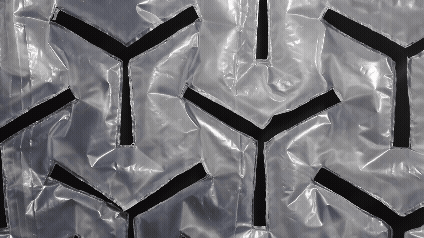
Withheld-Air is a responsive boundary composed of an 8 × 4 grid of Y-shaped pneumatic units. As the cells inflate, neighboring units press together, causing the openings to contract inward through a mechanism inspired by auxetic structures.
The system reads EEG signals in real time and uses Frontal Alpha Asymmetry (FAA) to indicate approach or withdrawal tendencies. When withdrawal is detected, the boundary thickens and closes, reducing visual connection between participants. The project explores how psychological states can be translated into dynamic spatial boundaries.
01—BEHAVIORAL CONDITION
Social Retreat
Social retreat refers to a gradual reduction in participation during interpersonal interaction.
Rather than an explicit withdrawal, it is often expressed through hesitation, avoidance, or reduced openness in communication. In psychological research, social retreat is understood as a relatively stable behavioral tendency that can appear across different social contexts. Individuals with stronger withdrawal tendencies may be more likely to disengage when facing uncertainty, social evaluation, or unfamiliar interpersonal situations.
Measurement
Frontal Alpha Asymmetry (FAA) is an EEG-based measure commonly used in cognitive neuroscience to assess emotional states and behavioral tendencies.
Research suggests that FAA reflects an individual’s underlying approach–avoidance tendencies when encountering novel or challenging situations (Harmon-Jones et al., 2010).


FAA = ln(α_R) − ln(α_L) > 0:
Greater relative left frontal cortical activity is generally associated with approach motivation, exploratory tendencies, and positive affect.

FAA = ln(α_R) − ln(α_L) < 0:
Greater relative right frontal cortical activity is generally associated with withdrawal tendencies, anxiety, behavioral inhibition, and negative affect.

Alpha
-
Sensory inhibition
-
Attentional filtering
-
Internal and external attention
Beta
-
Active cognition
-
Task execution
-
Motor preparation
Delta
-
Deep sleep
-
Bodily stability
-
Autonomic nervous system activity
Theta
-
Memory
-
Internal attention
-
Imagination
Muse 2 records four EEG channels (TP9, AF7, AF8, TP10), with each channel containing information across multiple frequency bands, including Delta, Theta, Alpha, Beta, and Gamma. This project uses only the Alpha band (8–13 Hz) from AF7 and AF8 to calculate Frontal Alpha Asymmetry (FAA). Beta and Gamma are used only as supplementary indicators for monitoring brain state and do not participate in controlling the installation.
Mediation
Research in environmental psychology suggests that visibility is not merely a visual property, but an important spatial variable that shapes social behavior. By regulating visual connections between people, spatial boundaries can influence perceptions of privacy, comfort, and willingness to engage socially (Altman, 1975; Hillier, 1996).
Environments that allow individuals to control their degree of visual exposure can enhance psychological comfort and a sense of safety, while excessive exposure may increase stress and encourage avoidance behaviors (Kim & de Dear, 2013).
Installation
Design
The installation is composed of Y-shaped pneumatic cells tiled into an 8 × 4 array.
Unlike conventional hexagonal pneumatic cells, which mainly expand outward during inflation, the Y-shaped geometry produces a more directional change in aperture. As internal pressure increases, the arm-like structures of neighboring cells gradually press against one another, compressing and closing the gaps between them.
As a result, the overall field exhibits a spatial behavior of contraction rather than expansion. This behavior is inspired by auxetic structures with negative Poisson’s ratio, but emerges primarily from the interaction between adjacent cells rather than from the deformation of a single unit.


As approach tendency increases (higher FAA), the pneumatic structure gradually opens

When the participant shows a stronger withdrawal tendency (lower FAA), the structure progressively contracts

Spatial Density
The installation is arranged with varying densities rather than uniformly distributed across the space. Moderate spacing allows participants to move freely while continuously shifting lines of sight, turning encounters, crossings, and pauses into spatial events.
Visibility Corridor
The units are staggered rather than aligned linearly, creating a series of visibility corridors. As participants move, visual connections are continuously established, interrupted, and re-established, making visibility a dynamic spatial condition.
Responsive Boundary
Rather than functioning as fixed partitions, the modules continuously adjust their degree of enclosure in response to EEG signals. The boundary becomes a dynamic medium, constantly reshaping visibility, perceived distance, and spatial relationships between participants.
Prototype

Form Exploration
Compare different pneumatic cell geometries and their deformation behaviors
Prototype Fabrication
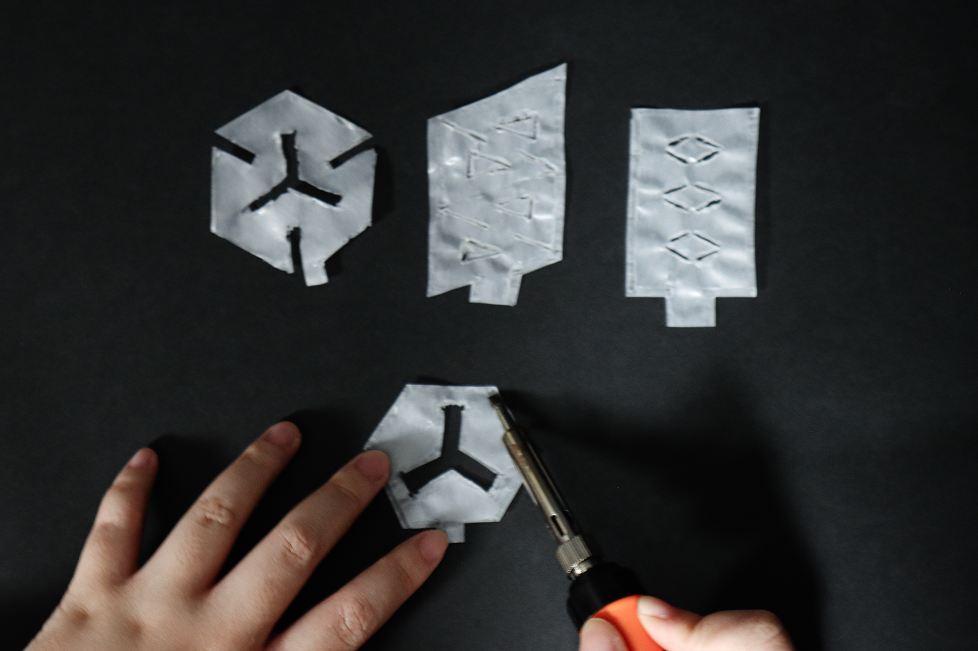
Fabricate different inflatable units using PE film and heat-sealing technique

Inflation Testing
Evaluate structural deformation and responsive behavior during inflation
Digital Fabrication
Considering material performance, fabrication methods, and architectural-scale requirements, the project ultimately selected 0.1–0.2 mm PE film for the pneumatic cells. Its lightweight, low-cost, heat-sealable properties make it suitable for rapid prototyping and large-scale inflatable fabrication.
The Y-shaped cell geometry was generated parametrically, then translated into cutting templates using a Zünd digital cutting system. Multiple layers of PE film were subsequently joined through manual heat welding to form airtight pneumatic units.
-
Parametric generation of Y-shaped cells
-
Zünd digital plotting and cutting
-
Manual heat welding of PE film


Digital Plotting with Zünd

Pneumatic Unit after Heat Sealing
Technical Pipeline

Real-time
EEG Interface
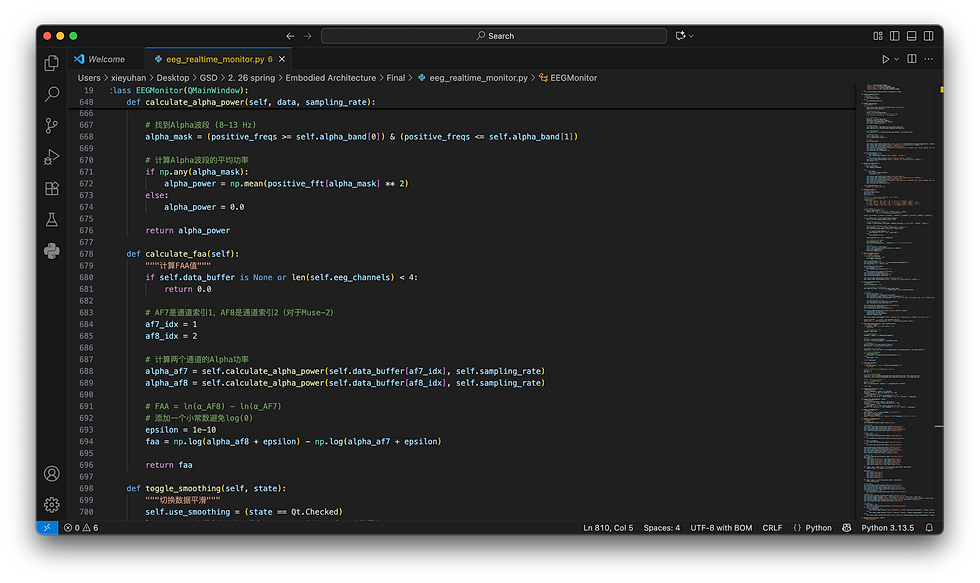
The software was developed using Python + PyQt5 to acquire and analyze Muse 2 EEG data in real time and calculate Frontal Alpha Asymmetry (FAA). It integrates EEG acquisition, baseline calibration, real-time analysis, data visualization, and state feedback, providing a continuous and stable control signal for the responsive system.
Signal Processing

Final Outcome